

How to Elope in California: A Step-by-Step Guide

California is a gorgeous state to elope because there’s something for every kind of couple—from breathtaking beaches and towering redwoods to desert landscapes and majestic mountains. California’s wide-ranging scenery, year-round mild weather, and laid back vibe make it easy to find the perfect backdrop for your special day. The question is — how to elope in California?
The steps to make your marriage legal, whether an elopement, a micro wedding or a traditional wedding, can feel complicated and tedious. With some planning and a little bit of help, it can be done quickly and stress free! Here, we’ll review:
- How to obtain a marriage license
- How many witnesses are required
- All inclusive California elopement packages
- Top booked venues in California on Simply Eloped
- Post elopement: getting a marriage certificate
- Post elopement: changing your last name

How to Get your Marriage License
Your marriage license is the most important part of your marriage process. This is because to get married in California, or really anywhere in the US, you need a marriage license. To obtain that, you need to go in person to the County Clerk’s office to apply for your marriage license. You do not need to be a resident of California in order to get married in California.
You’ll need to bring a valid picture ID with you to apply for your marriage license. Valid picture identification is one that contains a photograph, date of birth, and an issue and expiration date, such as a state-issued identification card, drivers license, passport, military identification, etc. Some counties may also require a copy of your birth certificate. If you’ve been married before, you’ll also need to provide the date your marriage ended and how it ended.
The marriage license application fee is $82.00. Once you receive your marriage license it expires after 90 days, and there is no required waiting period between getting your marriage license and getting married in California, so you can do both on the same day.
Obtaining a Wedding Officiant and Witnesses
To elope in California, you’ll need an authorized person to officiate your marriage. This person can be:
- A priest, minister, or rabbi of any religious denomination.
- A judge or retired judge, commissioner of civil marriages or retired commissioner of civil marriages, commissioner or retired commissioner, or assistant commissioner of a court of record in this state.
- A judge or magistrate who has resigned from office.
- Any of the following judges or magistrates of the United States.
- A justice or retired justice of the United States Supreme Court.
- A judge or retired judge of a court of appeals, a district court, or a court created by an act of Congress the judges of which are entitled to hold office during good behavior.
- A judge or retired judge of a bankruptcy court or a tax court.
- A United States magistrate or retired magistrate.
- A legislator or constitutional officer of this state or a member of Congress who represents a district within this state, while that person holds office.
You will also need at least one witness to your marriage.
All Inclusive California Elopement Packages
Simply Eloped offers a number of customizable elopement packages for your California Elopement! Our Seed, Simply Photographed, Sprout, Bloom, and Oasis packages are available in California. This provides each couple the unique opportunity to build their perfect, customizable elopement package from top to bottom. Here are a few details on each package. To see more information on each of these California elopement packages, click here.
- Seed Package Details: Includes professional officiant, personalized ceremony, advice on obtaining your marriage license and dedicated Elopement Specialist.
- Simply Photographed Details: Covers one hour of professional photography and dedicated Elopement Specialist.
- Sprout Package Details: Offers a professional officiant, personalized ceremony, one hour of photography, and dedicated Elopement Specialist.
- Bloom Package Details: Includes a professional officiant, personalized ceremony, one hour of photography, a Nosegay bouquet and boutonniere, and dedicated Elopement Specialist.
- Oasis Package Details: Covers professional officiant, two hours of photography, one hour of videography, hair and make up for one person, a Nosegay bouquet and boutonniere and dedicated Elopement Specialist.
- Wildflower Package Details: Our most customizable package. Includes a professional officiant, four hours of photography, coordinated transportation, customizable floral arrangements and a dedicated Elopement Specialist.
Our Favorite Places to Elope in California
Emerald Bay State Park Lookout, Lake Tahoe
Emerald Bay Lookout is a beautiful spot overlooking Fannett Island and the turquoise lake encircled by glistening mountain peaks dotted with cedar, pine and fir trees. This venue is available for ceremonies year round but can only be booked between April and November. This venue can accommodate up to 15 guests (including the couple and vendors). This venue does require a permit, but Simply Eloped’s got you covered.
This venue is wheelchair accessible, and does allow for streaming, so you can have guests tune in from afar, though service can be spotty. Chairs and decor are not allowed, and as it’s in a state park, alcohol is not permitted and you will need to “Leave No Trace.” Dogs are allowed but must remain on a leash. You can play either acoustic music or a playlist from a small bluetooth speaker. There is street parking available on site.
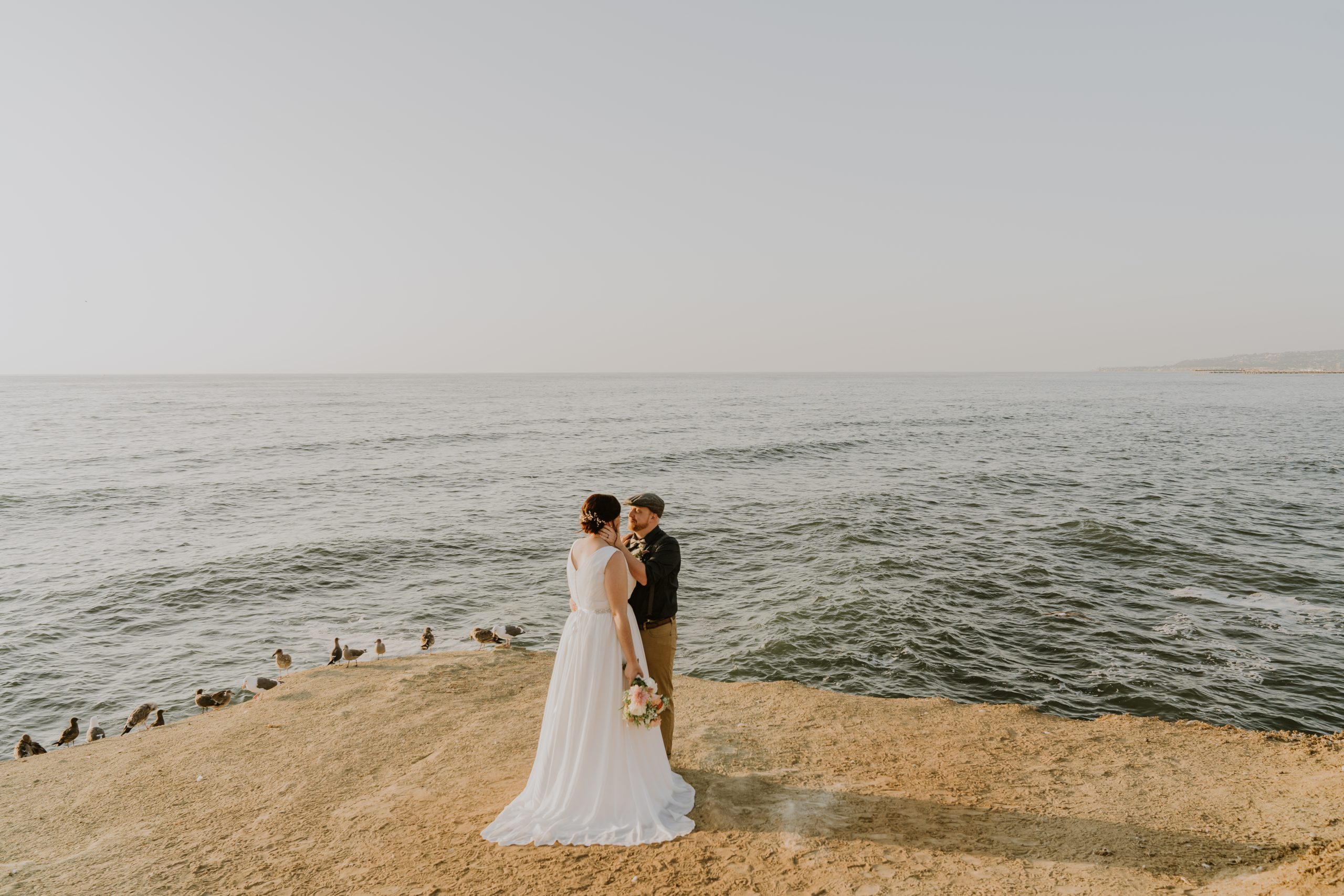
Sunset Cliffs, San Diego
Sunset Cliffs is one of the best spots to catch a sunset in all of San Diego. If you envision exchanging vows cliffside with the Pacific Ocean as your backdrop, this would be the perfect venue to start your next chapter. You can hold your ceremony at Luscomb’s Point or Osprey Point, and this spot is available for your elopement year round except for memorial day weekend, July 3rd and 4th, and labor day weekend. A permit is required and you and your partner will need to apply for it at least 30 days in advance of your preferred ceremony date. There is a $200.00 fee associated with this permit.
This venue can accommodate larger parties of up to 50 guests (including the couple and vendors). Chairs and decor (like arches) are allowed, however they must be approved during the permit process and candles and sparklers are not allowed. This venue is not wheelchair accessible. As this venue is in a public park, alcohol is not permitted, and dogs are allowed but must remain on a leash. You can play either acoustic music or a playlist from a small bluetooth speaker. There is street parking available on site.
Balboa Park, San Diego
This 1,200 acre urban park is home to stunning gardens, archways and columns, making it the perfect backdrop for an outdoor elopement. In fact, there are almost 20 different locations within the park that you can choose from for your ceremony. A permit is required and you and your partner will need to apply for it yourselves, in person at the park’s office. There is a $190.00 fee associated with this permit. This venue is available year round and can be booked for ceremonies at any time, however we’d recommend reaching out at least a month or two ahead of your preferred ceremony date to give the park time to respond.
This venue can accommodate up to 30 guests (including the couple and vendors). Chairs and decor may be allowed depending on which location within the park you choose to hold your ceremony, however candles and sparklers are not allowed. As it’s a public park, alcohol is not allowed, and dogs are allowed, but must remain on a leash. There are 11 free parking lots available around the park.
Coronado Beach, San Diego
If you’re envisioning a classic beach elopement, Coronado Beach is the perfect spot to exchange vows at sunset with your feet in the sand. This venue is available year round for ceremonies at South Beach, Central Beach and North Beach. You will need a permit if you’d like more than 25 guests to attend your elopement and you will need to apply for that permit with your partner, but if you have 24 or fewer guests, you do not need a permit. If you do want to apply for a permit, the application must be submitted a minimum of 30 working days ahead of your preferred ceremony date. There is a $25.00 nonrefundable application fee and the permit costs $150.00.
This venue is wheelchair accessible, and beach wheelchairs are available. Chairs and decor are generally not allowed except for minimal, small decor like a rug to stand on. If you’re applying for a permit for more than 25 guests, you can confirm decor with the permitting office directly. Candles and sparklers are not permitted. Dogs are allowed on the North end of the beach. There is street parking all along the beach.
Logan Shoals Vista Point, Lake Tahoe
Logan Shoals Vista Point is exceptional for sunset ceremonies where the alpenglow lights the sky. There’s a private rock enclave just off the accessible path that’s perfect for an intimate ceremony. This venue is available for ceremonies year round, however we recommend planning your elopement between May 25 and November 15 when the bathrooms are open. One note is that this venue cannot be booked without an officiant. This venue can accommodate up to 15 guests (including the couple and vendors). This venue does require a permit, but Simply Eloped’s got you covered.
This venue is wheelchair accessible, and does allow for streaming, so you can have guests tune in from afar, though service can be spotty. Chairs and decor are not allowed, and as it’s in a state park, alcohol is not permitted and you will need to “Leave No Trace.” Dogs are allowed but must remain on a leash. You can play either acoustic music or a playlist from a small bluetooth speaker. There is street parking available on site, but parking is limited.
Get Your Marriage Certificate
The person who officiates your marriage will need to send the original marriage license to the County Clerk or County Recorder within 10 days of the date of your ceremony.
You will not automatically receive a copy of your marriage license, so if you need a copy of that license you will need to request and pay for a certified copy. It is recommended to get two. This is because as you’re changing your name, you’ll be using this document a lot. While in transition, it’s always good to have a backup in the event of an emergency.
How to Change your Last Name in California
To change your name in the state of California, you will need to fill out and file some forms with the court. There is a $435.00 – $450.00 filing fee. The clerk will give you a date when the judge will make a decision, but the process will take two to three months, because before a judge can decide, you must have the forms published in a newspaper for one month so the request shows up in the legal notice section of a newspaper. Once you receive the court order, you can use that documentation to have your identity documents updated.
To change your name on your legal documents after that, head to the Social Security Administration’s website, and fill out the questionnaire. Once completed, the website will tell you whether you can make the request to change your name online, or if you need to go to a local office to make the request in person.
After you’ve changed your name with the Social Security Administration, you can head to the DMV to update your driver’s license. Don’t forget to bring your current license, your certified marriage certificate, and an Official US Court Name Change document in order to change your name on your driver’s license.
To update your name on your passport, head to the US Department of State Bureau of Consular Affairs website.
- If it’s been less than one year since your passport was issued and your name was legally changed, you will need to submit form DS-5504, your most recent US passport, An original or certified document showing you changed your name less than one year after your most recent passport was issued like your marriage certificate, and a passport photo by mail. The instructions for mailing these items is on form DS-5504.
- If it’s been more than a year since your passport was issued or since you changed your name, you may be eligible to renew your passport by mail using Form DS-82 or apply in person using Form DS-11.
- You can renew by mail if your most recent passport is submitted with your application, is undamaged, was issued when you were 16 or older, was issued within the last 15 years, and was issued in your current name (or you can show the name change). If you meet all of these requirements, you can submit form DS-82, your most recent US passport, your original or certified name change document like your marriage certificate, one color passport photo, a fee (which will depend on your age) by mail to the address listed on form DS-82.
- To apply in person, find a location near you on the US Department of State Bureau of Consular Affairs that issues passports. You’ll need to bring form DS-11, evidence of US citizenship, your original or certified name change document like your marriage certificate, Valid ID and photocopy of that ID, one color passport photo, and a fee (which will depend on your age).
Once you’ve completed these steps, you’ve done the tallest task of completing your legal name change. You’ll then want to go through your accounts, credit cards, bank accounts, employers and insurance to make sure your name is up to date. It seems like a lot because it is! Take this process step by step, and it should all go smoothly. There’s also many businesses that help with the name changing process.
Eloping is an exciting moment in you and your partner’s life! Though there’s a few steps to get you down the aisle, Simply Eloped is here to support you in the full process. To learn more about our packages and services, chat with one of our Elopement Specialists.
This article has been fact checked and reviewed for accuracy by a Simply Eloped Elopement Specialist in January 2026.

Related Posts
San Francisco City Hall Weddings 101
Read ArticleRelated
Posts
Top Winter Elopement Locations That Won’t Wait for Spring
Read Article